
When a foreign contractor bills your Malaysian company for equipment, on-site installation and overseas work on one invoice, how should the withholding tax be assessed? One hypothetical RM1,000,000 invoice from a German equipment maker can require separate withholding analyses. A foreign contractor's mixed invoice for equipment, installation and overseas services needs separate withholding tax treatment in Malaysia. Overseas engineering also needs its own analysis. Treat the whole invoice the same way and you either deduct too much from your contractor or too little for the law.
The Inland Revenue Board of Malaysia (LHDN) administers these rules under the Income Tax Act 1967 (ITA 1967). Two provisions dominate mixed contracts: section 107A for contract payments to non-residents, and section 109B for special classes of income under section 4A. Which one governs your payment changes the rate, the form and the base you withhold on.
The stakes are higher than most payers expect. A late section 107A remittance can trigger a 10% increase on the unpaid withholding amount. Incorrect withholding can also affect the payer's business expense deduction, depending on the applicable rules. In practice, the biggest risk on a mixed invoice is rarely the arithmetic. It is the unsupported split between goods, Malaysian services and offshore work.
This article explains how to classify a mixed invoice and distinguish section 107A from section 109B. It covers defensible splits, the offshore exemption and the Malaysia–Germany treaty. The worked example is a clearly labelled hypothetical, and every rate is stated as at 2026. In this blog, we discuss the withholding tax analysis a Malaysian payer should complete before paying a foreign contractor's mixed invoice.
Table of Contents
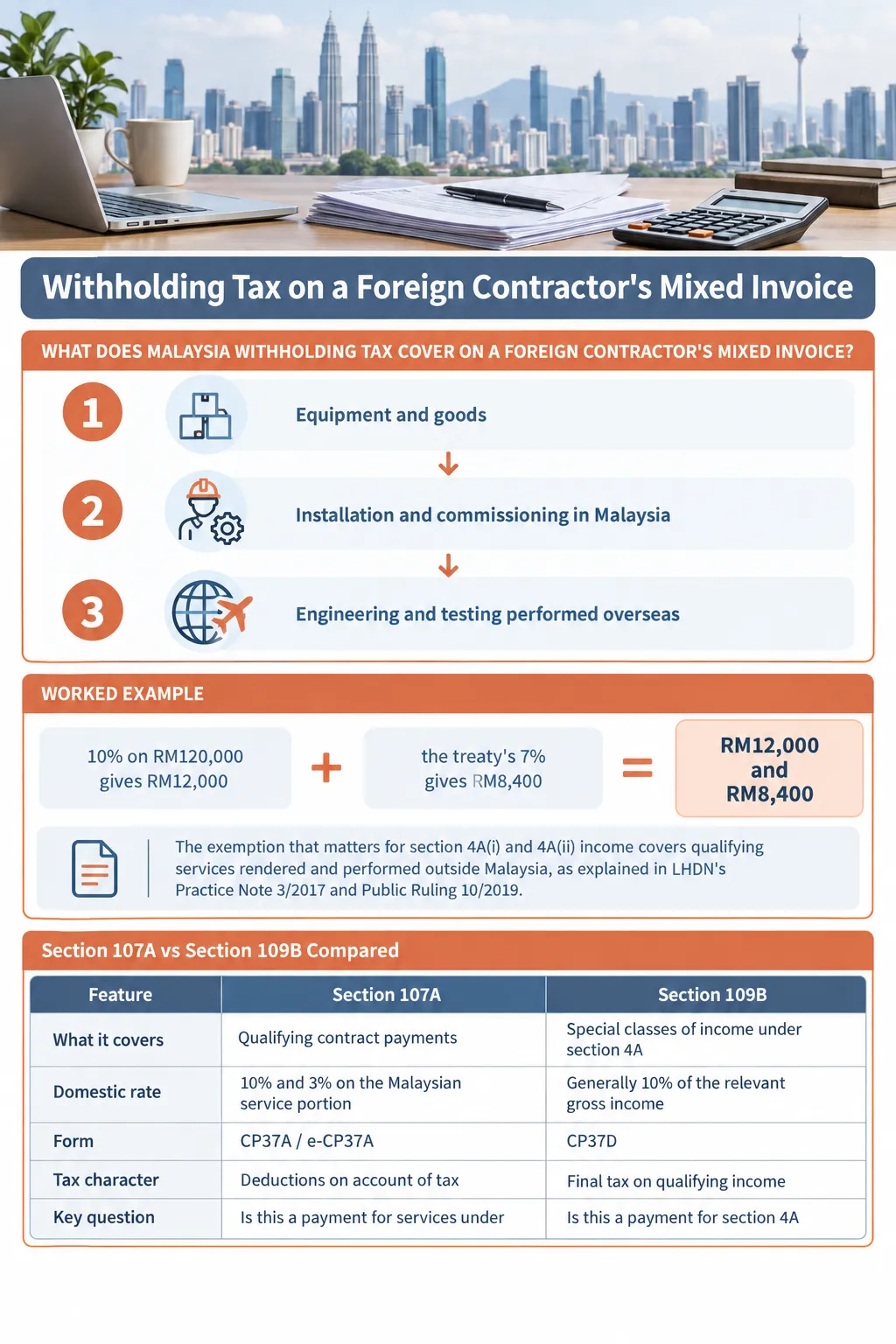
What Does Malaysia Withholding Tax Cover on a Foreign Contractor's Mixed Invoice?
A mixed invoice bundles a goods supply, services performed in Malaysia and services performed overseas into one contract, one milestone or one payment. Malaysian withholding rules do not automatically apply one rate to the whole invoice. They test what each part pays for, where the work happens, and which provision of the ITA 1967 covers it.
LHDN's withholding tax guidance lists the payment types, the governing sections, the rates and the forms. Equipment, installation and offshore engineering require separate analysis under those rules. Our article on whether Malaysian residents pay tax on foreign income received in Malaysia addresses a separate territorial question.
1. Equipment and goods
A genuine sale of goods is not a service fee, but one contract can contain both. LHDN's CP37A guidance distinguishes the gross contract payment from the service portion, so the equipment price needs its own pricing support before you leave it outside the base.
2. Installation and commissioning in Malaysia
Work physically done at a Malaysian site can fall inside the withholding base, depending on its classification. For section 107A, LHDN describes the service portion by reference to services performed or rendered for work or professional services in Malaysia under a contract.
3. Engineering and testing performed overseas
Overseas work is not automatically exempt. Its treatment depends on the income category, the evidence of where the work was done and, where relevant, treaty relief.
How Do Section 107A and Section 109B Differ for Foreign Contractor Payments?
Section 107A governs qualifying contract payments made to non-resident contractors. Section 109B governs special classes of income defined in section 4A of the ITA 1967. The two are not interchangeable labels for the same payment: classification turns on the statutory definitions and the obligations the contract actually creates.
Where a section 4A service contract involves work inside and outside Malaysia, LHDN's Public Ruling 10/2019 requires the Malaysian service value to be apportioned fairly and justifiably on the facts. The ruling's time-cost example is a method, not a mandatory percentage for every contract. A specialist should review the classification on each engagement.
1. What section 107A covers
Qualifying contract payments to non-resident contractors. LHDN's withholding tax guidance applies deductions of 10% and 3% to the Malaysian service portion, filed on form CP37A. The two rates are on account of different potential tax liabilities: one for the contractor and one for its employees.
2. What section 109B covers
Special classes of income under section 4A. These include installation or operational services connected with plant or machinery bought from the non-resident, advisory or management services, and rentals of moveable property. The domestic rate is generally 10% of the relevant gross income, filed on CP37D and treated as a final tax.
3. How the boundary is drawn
LHDN's Public Ruling 10/2019 gives a machinery installation example that can fall within section 4A and section 109B, but it does not settle every mixed contract. A contractor that undertakes a Malaysian installation project may instead sit under section 107A, and the vendor label, staffing model or title transfer alone does not decide the section. Treat the boundary as interpretation that needs specialist review.
Section 107A vs Section 109B Compared
| Feature | Section 107A | Section 109B |
|---|---|---|
| What it covers | Qualifying contract payments to a non-resident contractor | Special classes of income under section 4A |
| Domestic rate | 10% and 3% on the Malaysian service portion | Generally 10% of the relevant gross income |
| Form | CP37A / e-CP37A | CP37D |
| Tax character | Deductions on account of tax | Final tax on qualifying income |
| Key question | Is this a payment for services under a contract? | Is this a payment for section 4A special-class income? |
How Do You Split Equipment, Installation and Overseas Work on One Invoice?
You split the invoice on evidence, never on the invoice headings alone. Use pricing records to test the selling price of the goods and each service element. Costs can help test an allocation, but do not automatically determine it. This differs from the ruling's time-cost method for apportioning relevant services between locations.
Take a clearly hypothetical example, an illustrative scenario rather than a client record. A German-resident industrial equipment contractor supplies a production-line module to a Malaysian manufacturer under one supply-and-install contract. A single RM1,000,000 milestone invoice comprises RM700,000 for equipment, RM200,000 for installation and commissioning in Malaysia, and RM100,000 for separately identifiable engineering and factory-testing work performed in Germany. Two engineers spend six weeks at the Malaysian factory, and the contract permits Malaysian withholding.
The figures, residence, scope, personnel and timing are unconfirmed illustrative assumptions, not engagement facts. On those assumptions the split is 70%, 20% and 10% of the invoice value. If a specialist confirms section 107A applies to the RM200,000 Malaysian service portion, the illustrative deductions are RM20,000 on account of the contractor's tax and RM6,000 on account of its employees' tax. That would leave RM26,000 withheld in total and RM974,000 paid to the contractor. The calculation does not establish the classification; specialist review of the complete scope is needed.
The equipment price may sit outside the service base if it is a genuine, supported goods supply. That is an interpretation requiring specialist review. Quotations, purchase records and shipping documents can help test it, but their availability here is assumed. A mixed-contract label or unsupported allocation does not establish the split. Embedded software royalties, rentals and services need separate analysis.
If the contractor refuses to itemise, consider holding payment under the payer's approval process. Request a signed allocation supported by records; a separate invoice can help but is not essential. If payment cannot wait, document the unresolved exposure and obtain specialist advice on a defensible withholding position.
Is Work Performed Overseas Automatically Exempt From Malaysian Withholding Tax?
No. The exemption that matters for section 4A(i) and 4A(ii) income covers qualifying services rendered and performed outside Malaysia, as explained in LHDN's Practice Note 3/2017 and Public Ruling 10/2019. It is not a blanket exemption for every payment labelled offshore. Royalties and equipment rentals need their own analysis.
For section 107A, the same discipline applies from the other side. The service portion is defined by reference to services performed or rendered in Malaysia. An engineer advising remotely from Germany is not working in Malaysia merely because the machine is here. But an offshore invoice heading settles nothing on its own: the fee must genuinely reward the offshore work, not the completion of the Malaysian installation.
Where a task's location stays unresolved, record it in the advice file before payment. Note the task, the amount attached to it, the missing evidence, the contractor's explanation and the potential tax consequence, and take specialist advice on the withholding position. Until the location is substantiated, do not sign off an offshore exclusion for that task.
The Illustrative RM1,000,000 Mixed Invoice Split
| Invoice element | Amount (RM) | Withholding treatment |
|---|---|---|
| Equipment supply | 700,000 | Outside the service base if it is a genuine, supported goods sale |
| Installation and commissioning in Malaysia | 200,000 | Section 107A: 10% = RM20,000 plus 3% = RM6,000 |
| Engineering and factory testing in Germany | 100,000 | Excluded only if the offshore work is substantiated |
| Total invoice | 1,000,000 | RM26,000 withheld; RM974,000 paid to the contractor |
Can the Malaysia–Germany Treaty Reduce Withholding on Technical Fees?
Potentially. Article 12 of the Malaysia–Germany agreement generally caps Malaysian tax on qualifying technical fees at 7% of the gross amount, where its conditions are met, as at 2026. The cap is not automatic. You must check the payee's residence, beneficial ownership, the character of the fee, whether it is effectively connected with a permanent establishment, applicable treaty modifications and the relief procedure.
A 7% cap on technical fees is not a general replacement for both section 107A deductions, and the treaty does not decide the domestic classification. In our team's judgement, a short site visit alone does not settle the permanent-establishment or technical-fee questions. Review the treaty's project, supervisory, fixed-place and agency provisions, including connected activities, premises, agency facts and applicable treaty modifications.
To see the arithmetic difference, vary the hypothetical. In a separate hypothetical, suppose a machinery vendor sells equipment for RM800,000. It provides ancillary installation services worth RM120,000 in Malaysia and RM80,000 of German engineering. Two engineers visit for 20 days; there are no civil works or integrated factory-project obligation. If the installation assistance qualifies as section 109B special-class income, 10% on RM120,000 gives RM12,000, while the treaty's 7% gives RM8,400. The figures and contract facts are unconfirmed illustrative assumptions. The ruling's installation example does not settle every mixed contract. Arithmetic establishes neither section 109B classification nor treaty entitlement; both need specialist sign-off.
If treaty treatment cannot be established before the withholding deadline, escalate before payment. Determine a defensible domestic withholding and relief position, and verify the applicable relief procedure. A ruling request does not suspend the deadline. Deal separately with any applicable contractor and employee components.
What Evidence Should You Keep Before Paying a Non-Resident Contractor?
Build the evidence file before the payment date, not after. Our team's professional judgement is to look first at the contract obligations, then at pricing support, work-location records and treaty documents.
Our team sees how missing engineer-day records or offshore deliverable evidence can leave an allocation unsupported. Consider holding payment under the payer's approval process and requesting a signed allocation supported by records. Document the unresolved exposure and obtain specialist advice rather than manufacture a favourable split. The checklist is a practical proposal, not a list of documents that are all legally mandatory.
1. Classification documents
The signed contract, the scope of works and the milestone definitions show what the contractor actually undertook. They are what decides which provision governs the payment.
2. Work-location records
Engineer travel dates, site-access records, daily installation reports and commissioning sign-off evidence the Malaysian work. Offshore deliverables need their own timesheets, revision histories, test reports and acceptance records.
3. Payee-residence documents
A tax-residence certificate from the contractor's home jurisdiction, covering the payment period, is the starting point for any treaty claim. Identify the contracting party and the payment recipient carefully.
Evidence File Before Paying a Mixed Invoice
| Evidence | What it supports |
|---|---|
| Signed contract and scope of works | The obligations that decide section 107A vs section 109B |
| Itemised invoice or signed allocation | The split between equipment, installation and offshore work |
| Quotation, purchase and shipping records | The genuine equipment selling price |
| Engineer travel, site access and daily reports | Where the Malaysian installation was performed |
| Timesheets, deliverables and test records | The substance and location of the offshore work |
| Tax-residence certificate | The payee's identity and any treaty claim |
What Are the Filing Deadlines and Penalties for Withholding in Malaysia?
For section 107A, the payer generally remits to LHDN within one month after payment or crediting, whether or not tax was deducted. Confirm the trigger date and any written direction or extension. Section 109B has its own timing rules and limited small-payment deferral procedures.
LHDN lists CP37A and CP37D in its online e-WHT service, so submissions can generally be filed and paid electronically. Confirm the live submission, payment-reference and supporting-document workflow on the Inland Revenue Board of Malaysia (LHDN) website before each payment run.
Late remittance bites twice. LHDN's e-CP37A explanatory notes describe a 10% increase on the unpaid withholding amount where a section 107A remittance is late, under section 107A of the ITA 1967. Incorrect withholding can also put the payer's income tax deduction for the expenditure at risk. Public Ruling 10/2019 explains the disallowance and the effect of paying the tax subsequently, though the outcome depends on the payment type, timing and statutory exceptions.
Penalty mechanics reach further than withholding, as our guide on LHDN penalties without a notice explains. If the mixed contract changes your company's own taxable income, read our article on tax estimate submission in Malaysia using Form CP204 to check whether the instalment plan needs revising.
Conclusion
Malaysia withholding tax on a foreign contractor's mixed invoice is several questions at once: what the payment buys, where each service was performed, which provision governs and what the evidence supports. If section 107A applies to the illustrative Malaysian installation portion, deductions are 10% plus 3%. A genuine equipment sale and substantiated offshore work may sit outside that base. The assumptions and classification require specialist review.
The Malaysia–Germany treaty can cap qualifying technical fees at 7%, but only after the residence, ownership and permanent-establishment checks are done, and never as a shortcut around the domestic classification. Where the position cannot be settled before the deadline, escalate before payment. Determine a defensible domestic withholding and relief position, and verify the applicable procedure.
At Malaysia Taxation, we help payers classify mixed invoices, build the evidence file, calculate the withholding and file the forms with LHDN on time. Get in touch before the first payment, not after the penalty notice.
Review Your Mixed Invoice Before You Pay
Send us the contract and the invoice. Our tax specialists will classify the payment, compute the withholding and handle the LHDN filings.
Frequently Asked Questions
No. Withholding applies to the parts that fall within the relevant provision, typically the Malaysian service portion. A genuine, supported equipment sale can sit outside the service base. Offshore work needs substantiation and an assessment under the applicable provision.
Under section 107A, LHDN applies deductions of 10% and 3% on the Malaysian service portion of qualifying contract payments, filed on CP37A. Where the payment instead qualifies as section 109B special-class income, the domestic rate is generally 10% of the relevant gross income, filed on CP37D.
No. The exemption covers qualifying section 4A(i) and 4A(ii) services performed outside Malaysia, and only where the income category, substance and location are evidenced. Royalties and equipment rentals need separate analysis.
Potentially, to 7% of qualifying technical fees where the treaty's conditions are met. The cap is not automatic and does not replace the domestic classification. Check payee residence, beneficial ownership, the fee's character and any permanent establishment first.
A late section 107A remittance can trigger a 10% increase on the unpaid amount, and incorrect withholding can also put the payer's tax deduction for the expenditure at risk. The remittance deadline is one month after paying or crediting the payee.
Malaysia Taxation
Author
Malaysia Taxation explains Malaysian tax in plain English: personal income tax, withholding tax, SST and LHDN filing rules and deadlines.