Your employer deducts tax from your salary every month, so why has the Inland Revenue Board of Malaysia (LHDN) sent you a CP500 instalment notice as well? Our detailed guide on when are company directors liable for unpaid tax in Malaysia sets out exactly when LHDN can pursue you personally. In most cases the notice targets your side income, not your employment pay. Amending it with a CP502 only makes sense after a careful reconciliation, not as a reflex.
CP500 can apply to individuals who receive both employment and non-employment income, and LHDN announced a penalty concession for eligible individuals for YA 2026. Your monthly salary deduction, the Monthly Tax Deduction (PCB), already covers employment income. If that pay includes perks such as housing, our guide on how employee benefits like accommodation are taxed in Malaysia shows what PCB should already capture. The estimate on the notice addresses the other source, such as freelance, business or rental income. If that business income flows through a company you help run, it is worth understanding your directors liability before the instalments fall due. If any of that side income comes from abroad, the rules on foreign sourced income under Malaysian income tax decide whether it belongs in your CP500 estimate.
That is why many salaried taxpayers received the form for the first time in 2026, often assuming the board had double-counted their pay. Usually it has not. Paying an inflated estimate ties up cash you may need later, while ignoring an accurate one leaves a shortfall at assessment.
This guide explains how LHDN builds the estimate, how to reconcile it against your PCB and current-year records, and how to amend CP500 with CP502 where the figure is materially wrong. It also covers the 2026 penalty waiver and the separate correction path when wrongly reported employment income sits behind the notice. In this blog, we discuss the reconcile-or-amend decision step by step, with a clearly labelled hypothetical example and the deadlines that apply as at 7 November 2026.
Table of Contents
When Should You Amend CP500 with CP502 Rather Than Just Pay It?
Amend only when a reconciled forecast shows the estimate is materially wrong; if it is broadly accurate, pay the instalments or reserve the cash for the year-end balance.
A CP500 is an instalment payment notice. LHDN issues it so a taxpayer settles tax on non-employment income in advance, across scheduled instalments, instead of one sum at assessment. For YA 2026, the scheme reaches individuals who receive both employment and non-employment income.
Some salaried people with freelance or rental side income may have received a CP500 notice for the first time for YA 2026, while others may have received notices in earlier years. The board's guidance states that, for a taxpayer with both sources, the estimate does not include the employment component already subject to scheduled deductions. That describes the general basis of estimation. It does not reveal the arithmetic behind any individual notice, so your own notice and processed returns still need checking.
A YA 2026 schedule typically spreads across six payment months, illustrated in the board's own CP502 example from March 2026 to January 2027. Read the amounts and due dates from your own notice rather than any general example. Companies estimate instalments through a separate mechanism, Form CP204, which we cover in another article.
1. What your CP500 estimate is based on
The board builds the estimate by reference to the tax payable for the preceding year of assessment, using the latest processed return. In the hypothetical case below, the notice is assumed to trace to an earlier return showing higher net freelance income. Treat that link as an assumption until you have pulled the actual return and the notice itself.
2. Why PCB does not make the notice wrong
Your monthly salary deduction and the CP500 instalments cover different income sources. For a combined-income taxpayer, the two sitting side by side is by design, not double taxation. The live question is whether the side-income figure inside the estimate is still supportable this year.
3. The reconciliation-first rule
We help clients reconcile the forecast annual tax and expected PCB before deciding anything about the notice. Salary deductions alone never establish that an estimate is wrong. That sequence is general professional guidance, and your own figures must drive the final call.
How Do You Reconcile a CP500 Estimate Against PCB and Side Income?
Run a full-year computation: combine both income sources, deduct reliefs, compute the tax, then compare PCB and the instalments against that forecast.
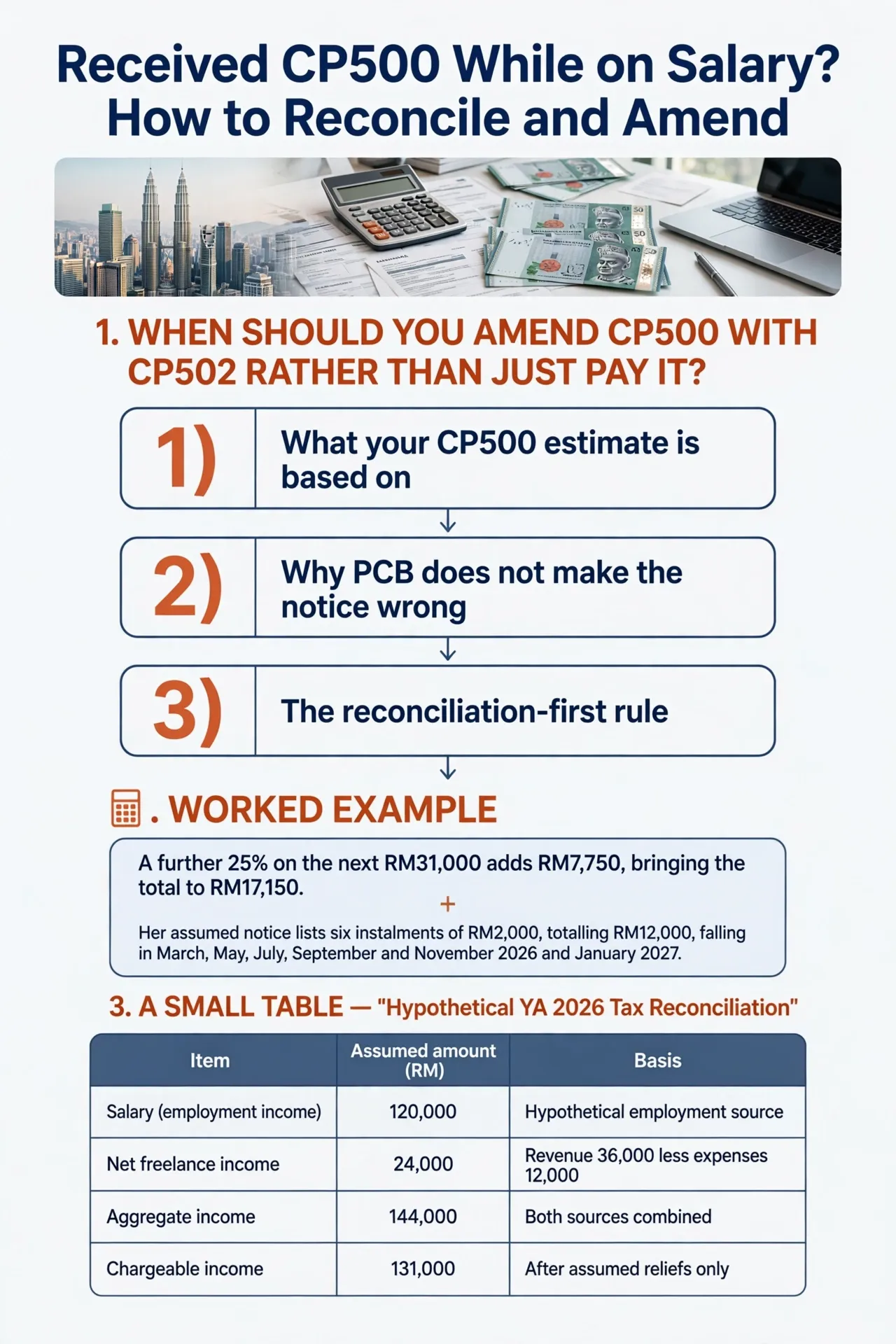
We illustrate with a hypothetical resident sole proprietor. These are model figures for illustration, not a documented case, and they still need confirming for suitability by a professional. She earns RM120,000 in salary, with assumed annual PCB of RM11,150. Her freelance design work yields assumed revenue of RM36,000 against deductible business expenses of RM12,000, leaving RM24,000 of net business income.
Aggregate income is therefore RM144,000. Assuming only RM9,000 of individual relief and RM4,000 of eligible Employees Provident Fund (EPF) relief, with no other adjustments, chargeable income is RM131,000. At resident individual tax rates, tax on the first RM100,000 is RM9,400. A further 25% on the next RM31,000 adds RM7,750, bringing the total to RM17,150. Check the official resident individual tax rates page for the year each scale applies to before relying on any rate.
Her assumed notice lists six instalments of RM2,000, totalling RM12,000, falling in March, May, July, September and November 2026 and January 2027. We assume the estimate reflects her last processed return, from an earlier year showing RM48,000 of net freelance income. The board describes estimates by reference to a preceding year of assessment, but never attribute your own notice to any return without reading it.
Two alternative outcomes follow. If all assumed PCB of RM11,150 is credited, RM6,000 remains payable at settlement. If all six instalments are paid instead, the eventual computation shows RM6,000 overpaid. Those are mutually exclusive forecasts, not simultaneous liabilities, and PCB already deducted may not be fully credited by November.
1. Forecasting side income for the year
Start from current-year records rather than the bank balance. In the illustration, revenue through September is RM27,000 and deductible expenses are RM9,000. That RM18,000 of net profit annualises to RM24,000, provided the final quarter resembles the first nine months. Check signed jobs, outstanding invoices, cancellations and recurring expenses before adopting it. Ask too whether an unusually large engagement behind the earlier figure will recur; here we assume it will not.
2. Counting taxable profit, not bank deposits
Forecast taxable profit, not money passing through your accounts. Loan proceeds and transfers between personal accounts are not income. Personal spending, owner's drawings and capital purchases are not deductible business expenses. Capital allowances deserve separate treatment, income recognition follows the applicable tax rules rather than cash receipts, and rental receipts need their own classification review.
3. Reading the difference
The comparison that matters is between an older, higher-profit tax record and a supportable current-year forecast. It is not the mere existence of PCB. Where the gap is material, the estimate becomes a candidate for a CP502 amendment. Where it is modest, paying or reserving usually beats the paperwork.
CP500 Versus PCB: What Each Covers
| Feature | PCB (salary deduction) | CP500 instalment notice |
|---|---|---|
| What it covers | Employment income from payroll | Estimated tax on non-employment income |
| Who pays | Employer deducts it monthly from salary | Taxpayer pays LHDN directly by instalment |
| Basis | Current-year remuneration and benefits | Preceding year's processed return, as stated on the notice |
| Credit at assessment | Credited against the year's final tax | Credited against the year's final tax |
| Correction route | Employer payroll correction | CP502 application, within the allowed windows |
How Does the CP502 Amendment Process Work in 2026?
CP502 is the prescribed application to revise CP500 instalments, but the ordinary YA 2026 windows closed on 30 June and 31 October 2026, and the form notes say late applications will not be considered.
CP502 is the prescribed application for amending CP500 instalments. Knowing how to amend CP500 with CP502, though, is only half the task; timing decides most of it. The January 2026 announcement set a first amendment by 30 June and a second by 31 October 2026.
The official documents differ slightly on the first window. The board's January 2026 announcement gives 30 June for a first amendment and 31 October for a second. The 2026 form notes instead allow a first application by 30 June or 31 October, with a second by 31 October. Whichever reading applies, both dates had passed by 7 November 2026.
We would never backdate a submission or describe a late request as an in-time amendment. Where a correction is still needed, approach the LHDN office handling the file. Acceptance of a late CP502 cannot be promised.
Step 1: Confirm the applicable window
Check the year of assessment on the notice and the current form notes before planning anything. The 2026 instructions list hand delivery, email, post and the board's online customer feedback form as submission channels. Confirm the channel the handling office currently accepts before sending, and keep the acknowledgement.
Step 2: Prepare the application and its pack
Use the current official CP502, completed and signed as required, with supporting documents attached. The board's feedback category expressly requests a completed CP502 with supporting documents. We suggest including the original CP500, a concise income forecast, a PCB reconciliation and management accounts. This is a proposed evidence pack, not a verified universal list of mandatory attachments.
Step 3: Track the revised instalment notice
A revised instalment notice, CP503X, will be issued after processing. An acknowledgement is not the revised schedule, so reconcile payments already made once the CP503X arrives. Remember that a downward revision can attract the 10% underestimation increase described in the form notes where the prescribed difference exceeds the statutory threshold. Do not assume the 2026 non-payment concession waives that separate increase.
Hypothetical YA 2026 Tax Reconciliation
| Item | Assumed amount (RM) | Basis |
|---|---|---|
| Salary (employment income) | 120,000 | Hypothetical employment source |
| Net freelance income | 24,000 | Revenue 36,000 less expenses 12,000 |
| Aggregate income | 144,000 | Both sources combined |
| Reliefs assumed | 13,000 | Individual 9,000 plus EPF 4,000, eligibility unconfirmed |
| Chargeable income | 131,000 | After assumed reliefs only |
| Tax at resident rates | 17,150 | 9,400 on the first 100,000 plus 25% on 31,000 |
| Annual PCB assumed | 11,150 | Fully credited in this forecast |
| Balance if no CP500 is paid | 6,000 | Payable at settlement |
| CP500 total if paid in full | 12,000 | Six assumed instalments of 2,000 |
| Result of paying in full | 6,000 overpaid | Against the same forecast |
What Does the 2026 CP500 Penalty Waiver Actually Cover?
HASiL announced no non-payment penalties in 2026 for eligible individuals with employment and non-employment income; coverage of the January 2027 instalment is unconfirmed, and the tax and filing obligations remain.
The board's January 2026 announcement says no penalty will be imposed in 2026 during the transition if eligible individuals do not pay the CP500 instalments. It also encourages voluntary payment to reduce the balance at filing. Eligible here means individuals receiving both employment and non-employment income for YA 2026.
Read the scope narrowly. The announcement refers to penalties in 2026 and to YA 2026 compliance. Without clarification, do not assume it covers the January 2027 instalment on a YA 2026 notice. Do not assume it reaches inaccurate-return penalties, late payment of the final balance, or YA 2027.
The concession never made side income tax-free. Business profits remain taxable, the annual return remains due, and the balance of tax must be settled by the applicable deadline. Our planning advice is to reserve the forecast RM6,000 from the illustration even if no instalment is paid. That reserve is planning, not a prediction of any waiver.
A taxpayer with business income generally files Form B, whose statutory manual deadline is 30 June in the following year. For YA 2026, confirm the 2027 filing programme and payment deadline when LHDN issues it. Our income tax return due dates roundup collects the timelines, and we would not assume an administrative e-filing extension.
Not every consequence is suspended either. Our overview of LHDN penalties explains what the board can impose even without a separate notice. Read it before skipping an instalment on the strength of a headline.
Contact us if you need help checking the scope against your own notice.
CP502 Amendment Windows for YA 2026
| Application stage | Ordinary deadline | Position on 7 November 2026 |
|---|---|---|
| First amendment | 30 June or 31 October 2026 | Window closed; see form notes |
| Second amendment | 31 October 2026 | Window closed |
| Late CP502 request | After 31 October 2026 | The form notes say late applications will not be considered; raise any outstanding correction with the handling office. |
| Revised instalment notice | Issued after processing | CP503X replaces the original schedule |
What the YA 2026 Waiver Does Not Cover
| Item | Covered by the announcement? |
|---|---|
| Waiver of penalties in 2026 for unpaid YA 2026 instalments (eligible individuals) | Yes, per the January 2026 announcement. |
| January 2027 instalment on a YA 2026 notice | Unconfirmed; seek clarification from HASiL |
| Tax on freelance or rental side income | No, business profits remain taxable |
| Form B filing obligation | No, the annual return remains due |
| Late payment of the final balance | Not stated; confirm scope before relying on it |
| YA 2027 instalments | No extension announced |
What If the CP500 Came from Wrongly Reported Employment Income?
Treat it as a source-correction exercise: match the employer's EA statement, payslips and PCB remittances against your filed return and the board's ledger before adjusting any instalment figure.
An estimate built on misreported employment income needs a different response from one that is simply high. Start by matching the employer's annual EA statement, payslips, taxable benefits, payroll totals and PCB remittances against the filed return and the board's ledger.
Three errors commonly hide behind one notice. Employment income may sit in a non-employment field on the return. PCB may be entered incorrectly on the return itself. Or payroll may have deducted PCB correctly while the board's records show it missing or misallocated. An inaccurate employer EA or payroll submission is a further problem again. Correcting your own return does not repair the employer's remittance record.
The correction route depends on the error, whether tax rises or falls, and timing. The board's 2026 filing guidance distinguishes routes within and after the filing period, including manual appeals and amended returns. Do not assume one route fits every payroll error. Confirm the assessment year, filing status and procedure for your own facts.
We suggest asking the employer's payroll lead to confirm employer-origin figures and, where necessary, having the employer correct its own records. Our proposed controls are a before-and-after source reconciliation, senior review and the taxpayer's approval before submission. These are general recommendations, not a description of an existing workflow or a specific case. Separately request correction of the resulting CP500, because fixing the old return does not automatically withdraw the notice.
1. Employment income in the wrong field
This misclassification distorts the non-employment estimate. Identify the affected assessment year, prepare the before-and-after source reconciliation, and choose the correction route that fits the error and its timing.
2. PCB figures that do not tie
Compare the return's PCB entry with payroll remittances and the board's ledger. Where payroll remitted correctly but the return is wrong, the return needs correcting. Where the board's records are incomplete, reconcile the employer's records with the ledger directly.
3. Who reviews and signs off
We recommend preparer reconciliation, senior tax review and taxpayer approval before any correction request is submitted. An authorised tax agent should submit where one is engaged, and the employer should confirm every employer-origin figure.
Conclusion
A CP500 arriving alongside salary deductions is usually an estimate on your side income, not a double charge. Reconcile the full-year position first: both income sources, reliefs, forecast PCB and the instalment total. Amend only where the gap is material and supportable.
For YA 2026, the ordinary CP502 windows closed on 30 June and 31 October 2026. Raise any outstanding correction with the office handling your file rather than assuming a late request succeeds. The concession covers certain non-payment penalties in 2026; do not assume it covers the January 2027 instalment. It does not remove the tax, any required return or the eventual balance.
Malaysia Taxation explains these rules in plain English. For hands-on help with reconciliations, CP502 applications or notice corrections, we point readers to professional tax services in Malaysia. Contact us for a second pair of eyes before the next instalment falls due.
Unsure Whether to Amend or Pay Your CP500?
A Malaysian tax professional can check the estimate, tidy your side-income records and deal with LHDN on your behalf before the next due date.
Frequently Asked Questions
Yes. From YA 2026 the instalment scheme covers individuals with both employment and non-employment income. The board's guidance says the estimate excludes the employment component already subject to scheduled deductions, so the notice generally targets your side income.
The announcement gives 30 June 2026 for a first amendment and 31 October for a second; the form notes also allow a first application by 31 October. The form notes say late applications will not be considered, so raise any outstanding correction with the office handling your file.
No. The concession suspends penalties in 2026 for unpaid YA 2026 instalments for eligible individuals; coverage of the January 2027 instalment is unconfirmed. The tax, the Form B filing obligation and the year-end balance all remain, so reserve the money you expect to owe.
The board's feedback category requests a completed CP502 with supporting documents. A typical pack includes the original CP500, a concise income forecast, a PCB reconciliation and management accounts. Confirm the current requirements and accepted channel before sending.
Not by itself. First match the employer's EA statement, payslips and PCB remittances against your filed return and the board's ledger. Then use the correction route that fits the error, its timing and whether tax rises or falls, and ask separately for correction of the notice.
Malaysia Taxation
Author
Malaysia Taxation explains Malaysian tax in plain English: personal income tax, withholding tax, SST and LHDN filing rules and deadlines.