
An overpayment on your company's Form C may not equal the cash LHDN pays back. A company's tax refund in Malaysia may be delayed by an offset or another unresolved issue. You filed the company Income Tax Return Form (Form C) on time, the return shows a credit, yet months later nothing has landed in the bank.
Under section 111(4A) of the Income Tax Act 1967, the Director General of Inland Revenue may apply a refundable excess against other tax amounts your company owes. So the repayment figure on your return is a starting figure, not a promised transfer. A credit can also be allocated to the wrong year, held for verification, or stopped by a bank-detail mismatch.
A stalled refund matters beyond cash flow. The same arrears that absorb your credit can attract penalties and, in certain circumstances, create personal exposure for directors. Directors facing that personal exposure often also ask how foreign income received in Malaysia is taxed for residents. Knowing whether your delay is an offset, a query or a banking problem tells you exactly what to fix.
In this blog, we discuss what to check before contacting LHDN and how to read the company e-Lejar. We also cover statutory periods, section 111D compensation and a practical follow-up sequence with LHDN.
Table of Contents
Why Can a Malaysia Company Tax Refund Delay Trace Back to Section 111(4A)?
LHDN may use your refundable credit to settle other amounts your company owes before paying anything back in cash. Section 111(4A) of the Income Tax Act 1967 permits the Director General to apply a refundable excess against specified amounts that are due and payable by the same person. The repayment line on Form C is therefore the starting point, not a guaranteed bank transfer.
Here is a purely illustrative example, and the figures are expressly hypothetical — they are not a record of any actual case. Assume a company's final income tax liability for the Year of Assessment (YA) 2024 was RM180,000, with no separate tax credits. It paid RM216,000 of CP204 instalments, all correctly allocated, so Form C showed RM36,000 repayable.
Now assume RM24,000 of that credit was transferred against an outstanding YA 2022 liability. Only RM12,000 would remain refundable in cash. A finance team that looked only at the YA 2024 computation and its payment receipts would expect RM36,000 and see nothing arrive.
An offset is a possibility, not proof of what happened in your account. Always confirm its amount and destination with LHDN. It also matters because arrears attract penalties, and in certain circumstances directors can become personally liable for certain unpaid company tax.
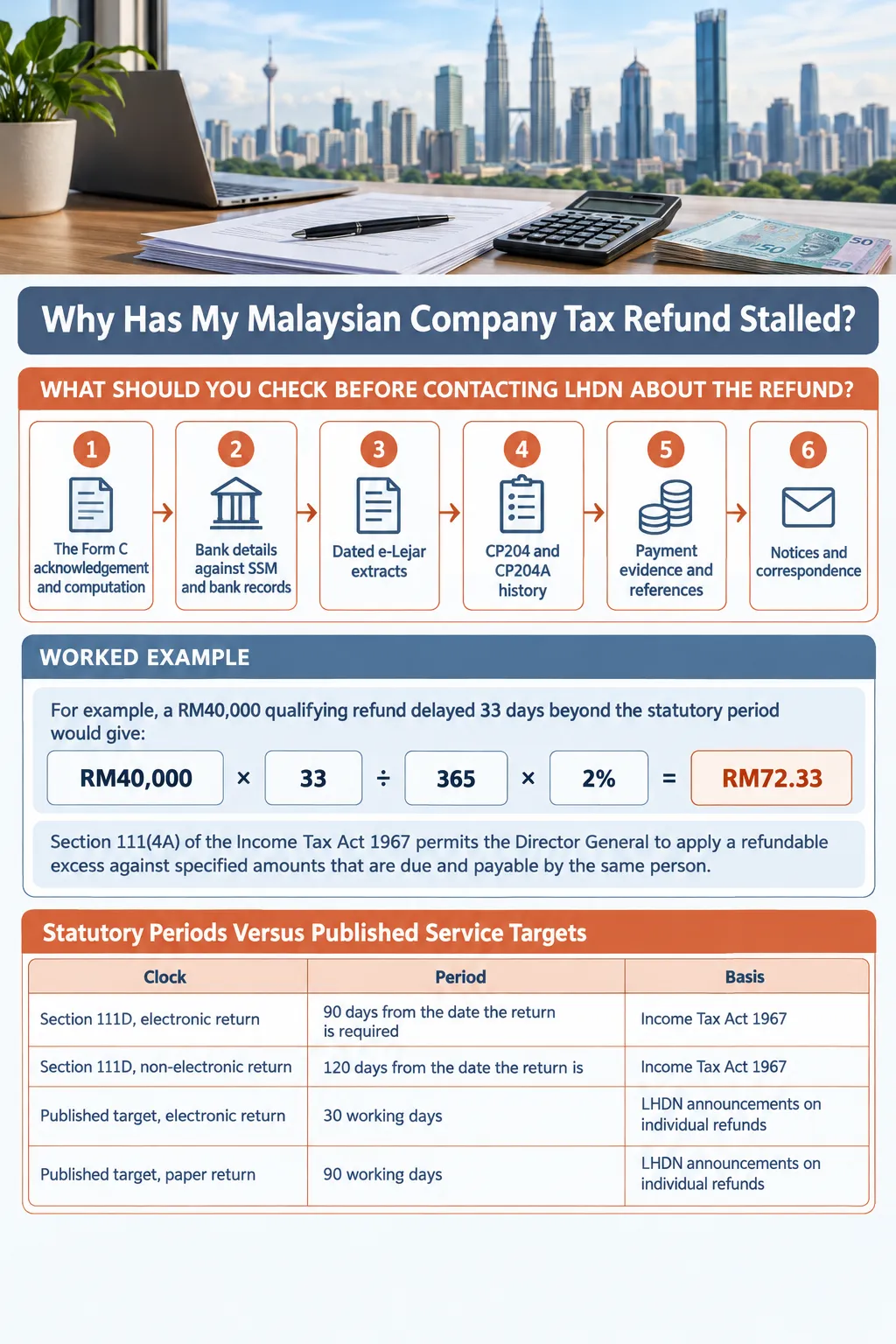
What Should You Check Before Contacting LHDN About the Refund?
Work through your own records before picking up the phone. Check the Form C acknowledgement and computation first, then bank details, then dated e-Lejar extracts, CP204 and CP204A history, payment evidence, and notices and correspondence. This is a proposed checking order, not a measured ranking.
1. The Form C acknowledgement and computation
Pull the actual submission acknowledgement, the filing date and the computation as submitted, not the preparer's draft. Confirm the repayment figure LHDN actually received. As a benchmark, Form C must be filed within seven months of the accounting period end, so verify the filing was inside the deadline.
2. Bank details against SSM and bank records
Check the account number, active status and account name as declared or registered with LHDN. For a company-owned account, compare them with current Companies Commission of Malaysia (SSM) records and the company's bank records. Watch for a former company name, a closed account or a director's personal account used by mistake. LHDN's collection framework contemplates certain third-party payments, so do not assume a universal company-owned-account rule; confirm the current bank-detail correction route with LHDN.
3. Dated e-Lejar extracts
Download e-Lejar extracts for the refund YA and for any other year showing an outstanding balance. Save dated copies. You are looking for payments, assessments, increases, transfers and refunds across all assessment years.
4. CP204 and CP204A history
Line up the tax estimate submitted on Form CP204, every revision on Form CP204A, the resulting instalment schedule and what was actually paid. A reduced estimate is not evidence that earlier instalments were refunded.
5. Payment evidence and references
Match each payment acknowledgement to the ledger: the e-payment or FPX reference, tax identification number, payment code, YA, instalment number and amount. For any historical cheque payment, retain both the receipt and clearance evidence. Note that LHDN discontinued cheque acceptance at specified collection channels from 1 August 2023.
6. Notices and correspondence
Collect assessment and additional-assessment notices, payment increases, offset correspondence, refund notifications, audit enquiries and any outstanding document requests. Requests sent only to a former tax agent or an obsolete address can sit unanswered for months.
Pre-Enquiry Checklist for a Stalled Company Refund
| Record | Where to find it | What to verify |
|---|---|---|
| Form C acknowledgement | MyTax submission records | Filing date, deadline compliance and the repayment figure actually submitted |
| Bank details | LHDN records and company bank statements | Account number and active status; for a company-owned account, compare the name with current SSM and bank records. Confirm LHDN's requirements for other arrangements. |
| e-Lejar extracts | MyTax e-Lejar | Payments, assessments, transfers and balances across all assessment years |
| CP204 and CP204A | MyTax instalment records | Original estimate, every revision and the final instalment schedule |
| Payment receipts | Bank statements and e-payment confirmations | Reference, payment code, YA, instalment number and amount |
| Notices and letters | Company and agent files | Assessments, offsets, audit enquiries and unanswered requests |
How Do You Check Your Company Tax Refund Status on e-Lejar?
LHDN's company e-Lejar shows recorded bank details, assessments, payments, repayments and the current tax balance for your company in one view. MyTax also carries a refund-status display for electronically filed returns, where available. Together, these are the fastest way to check your LHDN company tax refund status without calling anyone.
One caveat: LHDN announced the company e-Lejar facility back in 2013, so confirm the current access route through MyTax and what is visible for your company. Do not rely on second-hand descriptions of transaction labels — pull your own ledger and read the actual entries.
Compare dated e-Lejar entries across assessment years with your payment receipts and any offset correspondence. A matching transfer-out from the refund year and a transfer-in against an older debt is a strong clue to an offset. It should prompt an enquiry, but it is not conclusive without LHDN's allocation confirmation or other supporting evidence.
What Are the Less Obvious Reasons Company Refunds Stall?
From practical experience, a stalled refund usually has an explanation once you know where to look. The possibilities below are diagnostic patterns experienced practitioners look for. They are lines of enquiry, not documented findings about how often each cause occurs. A credit larger than the remaining balance alone does not prove wrong-year allocation. Confirm the allocation with LHDN before requesting a correction.
1. Wrong-year or wrong-reference allocation
Cash reached LHDN but was posted to the wrong YA or payment reference. The money exists; it is simply not where you expected. The dated ledger comparison in the previous section usually exposes this quickly.
2. An offset against older arrears
Under section 111(4A), an outstanding liability from another year can absorb your credit. A matching reduction in another year's debt within e-Lejar points this way. Confirm the amount and destination with LHDN before assuming it explains everything.
3. A bank detail mismatch or account change
A renamed company, a closed account or a mistyped account number can stop payment entirely. This needs a bank-detail correction with LHDN, not more correspondence about the tax computation.
4. An unanswered document request
A verification hold can persist while a request went to a former agent or an old registered address. A specific information request signals that the refund is being queried, not forgotten.
5. A rejected or returned payment
A refund approved internally can still fail at the bank. A returned or rejected payment needs payment-channel correction, not another argument about the tax position.
Offset, Verification or Genuine Delay: Signals to Compare
| Signal in your records | Likely situation | Next step |
|---|---|---|
| Matching transfer-out and transfer-in across years | Offset against arrears | Request confirmation of the offset amount and destination |
| A specific document request | Verification hold | Supply the information and confirm receipt in writing |
| A generic processing reply | Still queued, or cause not yet visible | Wait for the applicable period, then escalate in writing |
| Refund approved but no bank credit | Payment may still be pending or may have been rejected or returned | Confirm the payment status with LHDN and correct the bank details or payment channel if needed |
| Credit larger than the remaining balance | Possible wrong-year allocation | Confirm the allocation with LHDN, then request reallocation to the correct YA |
What Timeframes and Section 111D Compensation Rules Apply?
Two separate clocks govern timing. The Income Tax Act 1967 sets statutory refund periods, and a breach can attract compensation; separately, LHDN publishes service targets that are administrative, not guaranteed credit dates.
Section 111D, as consolidated at 1 January 2026, may provide compensation if a qualifying refund is made late. The statutory periods are 90 days for electronic returns and 120 days otherwise, from the date the return is required. If payment is late, compensation may be payable at 2% per annum on the qualifying amount for the days after the statutory period, using the formula A × B/C × 2%.
In that formula, A is the qualifying refund amount, B is the number of days after the statutory period until the refund is made, and C is the number of days in the year: 365 or 366. For example, a RM40,000 qualifying refund delayed 33 days beyond the statutory period would give: RM40,000 × 33 ÷ 365 × 2% = RM72.33. Check for amendments after the consolidation date, and get professional review of the exact endpoint wording before computing any claim — the statute and LHDN's older guideline describe the cut-off differently.
LHDN has also published working-day processing targets of 30 days for electronic returns and 90 days for paper returns. Those figures come from announcements about individual income tax refunds, so do not treat them as confirmed company-specific targets. Neither a service target nor a processing period is a guaranteed bank-credit date.
Section 111D also has express exclusions, including returns not furnished in accordance with sections 77 or 77A, specified section 111 excesses and appeals under section 99. LHDN's current guideline requires a correct and complete return and lists additional ineligible cases, including certain audit findings and overpayments not arising from scheduled instalments. The Act and administrative guidance are different things — an audit alone should not be described as an automatic statutory exclusion.
For late-filed returns, do not assume the compensation clock restarts at submission. The Act measures from the date the return is required, and LHDN's guideline treats a return submitted after the due date as ineligible. The effect of any filing concession needs case-specific review.
When Should You Follow Up, and How Should You Escalate?
Once your records reconcile and the applicable period has passed, follow up in a structured way. The sequence below is a practical workflow we suggest — it is not an LHDN-mandated procedure. Act sooner than the diary suggests if there is a rejected payment, an unanswered request or a live deadline. For help with the reconciliation or follow-up, contact Malaysia Taxation.
Step 1: Save the evidence
Download and date the MyTax refund-status result, where available, and the current e-Lejar extracts. Keep everything in one file alongside your reconciliation.
Step 2: Call the HASiL Contact Centre
Call LHDN's contact centre on the published number (03-8911 1000 — verify it on LHDN's website) to identify the office handling your file. Ask whether the refund is awaiting processing, held for information, offset or already issued. Record the date, any reference number and the explanation.
Step 3: Send a complete written enquiry
Write to the office handling the company's file, asking for it to be routed to the collection or refund function. A complete enquiry identifies:
- the company name and tax identification number (TIN)
- the YA, Form C submission date and acknowledgement
- the amount claimed and a liability-to-payment reconciliation
- relevant e-Lejar extracts and payment evidence
- any assessment, offset or audit correspondence
- verified bank particulars, sent through an appropriate secure channel
- tax agent authority, where applicable
Ask specifically for the outstanding requirement, any offset destination and amount, and the next action date.
Step 4: Diary the chase and escalate
One suggested diary point is a written chase after about 10 working days without a substantive response. You could then escalate to the supervising office and, if needed, LHDN's official feedback channel. This interval is a suggestion, not an LHDN requirement. A telephone call does not restart the waiting period, and a missed date an officer committed to justifies acting sooner.
Statutory Periods Versus Published Service Targets
| Clock | Period | Basis | Caveat |
|---|---|---|---|
| Section 111D, electronic return | 90 days from the date the return is required | Income Tax Act 1967 | 2% per annum compensation may apply after this period |
| Section 111D, non-electronic return | 120 days from the date the return is required | Income Tax Act 1967 | Late-filed returns are treated as ineligible under LHDN's guideline |
| Published target, electronic return | 30 working days | LHDN announcements on individual refunds | Not a confirmed company-specific target or guaranteed credit date |
| Published target, paper return | 90 working days | LHDN announcements on individual refunds | Confirm the current position for company refunds with LHDN |
Does Chasing a Refund Affect Appeal Deadlines?
No — and this catch is easy to miss. Section 111(3) of the Income Tax Act 1967 states that the refund provisions do not extend any appeal time limit or validate an otherwise invalid appeal.
If LHDN has also issued an assessment your company disputes, protect the objection timeline separately from the refund chase. Work out the relevant deadline for the actual notice and circumstances, and remember that penalties may be imposed even before a formal notice is issued when arrears remain unpaid. A refund enquiry and an appeal are two different matters running on two different clocks.
Conclusion
A stalled company refund may involve an offset under section 111(4A), a wrong-year allocation or a bank-detail mismatch. An unanswered request or returned payment is another possibility. Reconcile Form C to the e-Lejar before you call, use the ledger to locate the discrepancy, and follow up in writing once the applicable period has passed.
Section 111D sets statutory periods and a 2% per annum compensation mechanism. Its exclusions and timing rules need case-by-case review. A refund enquiry never extends an appeal deadline.
If a Malaysia company tax refund delay is holding up your cash flow, consider professional help. Malaysia Taxation explains these rules in plain English and connects you with professional tax services in Malaysia. These services can reconcile your ledger, draft the written enquiry and escalate with LHDN on your behalf.
Need Help Releasing a Stalled Company Refund?
A tax professional can reconcile your e-Lejar, identify any offset and manage the follow-up with LHDN for you.
Frequently Asked Questions
There is no guaranteed credit date. The Income Tax Act 1967 sets statutory periods of 90 days for electronic returns and 120 days otherwise, after which 2% per annum compensation may apply under section 111D. LHDN's published working-day targets come from individual-refund announcements, so confirm the current position for company refunds.
Yes. Under section 111(4A) of the Income Tax Act 1967, the Director General may apply a refundable excess against other tax (including instalments) or stamp duty your company owes that is due and payable. Confirm the amount and destination through e-Lejar or a written enquiry before assuming this is what happened.
Log in to MyTax and view the refund-status display for the filed return, then pull dated e-Lejar extracts across all assessment years. Compare ledger entries with your payment receipts and any offset correspondence before contacting LHDN.
Yes — a late-filed Form C generally removes the 2% compensation. The Act measures the statutory period from the date the return is required, and LHDN's guideline treats a late-filed return as ineligible for compensation. The effect of any filing concession needs case-specific professional review.
No. Section 111(3) of the Income Tax Act 1967 states that the refund provisions do not extend appeal time limits. Protect any objection deadline for a disputed assessment separately from your refund follow-up.
Malaysia Taxation
Author
Malaysia Taxation explains Malaysian tax in plain English: personal income tax, withholding tax, SST and LHDN filing rules and deadlines.